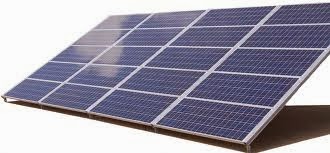
What is Solar Panel?
A
solar panel (also
solar module,
photovoltaic module or
photovoltaic panel) is a packaged, connected assembly of
photovoltaic cells.
The solar panel can be used as a component of a larger photovoltaic
system to generate and supply electricity in commercial and residential
applications. Each panel is rated by its DC output power under standard
test conditions, and typically ranges from 100 to 450 watts. The
efficiency of a panel determines the area of a panel given the same
rated output – an 8% efficient 230 watt panel will have twice the area
of a 16% efficient 230 watt panel.
Because a single solar panel can produce only a limited amount of power, most installations contain multiple panels. A
photovoltaic system typically includes an array of solar panels, an
inverter, and sometimes a
battery and or
solar tracker and interconnection wiring.
Background of Solar Panel
Photovoltaic solar cells are thin silicon disks that convert sunlight
into electricity. These disks act as energy sources for a wide variety
of uses, including: calculators and other small devices;
telecommunications; rooftop panels on individual houses; and for
lighting, pumping, and medical refrigeration for villages in developing
countries. Solar cells in the form of large arrays are used to power
satellites and, in rare cases, to provide electricity for power plants.
When research into electricity began and simple batteries were being
made and studied, research into solar electricity followed amazingly
quickly. As early as 1839, Antoine-Cesar Becquerel exposed a chemical
battery to
the sun to see it produce voltage. This first conversion of sunlight to
electricity was one percent efficient. That is, one percent of the
incoming sunlight was converted into electricity. Willoughby Smith in
1873 discovered that selenium was sensitive to light; in 1877 Adams and
Day noted that selenium, when exposed to light, produced an electrical
current. Charles Fritts, in the 1880s, also used gold-coated selenium to
make the first solar cell, again only one percent efficient.
Nevertheless, Fritts considered his cells to be revolutionary. He
envisioned free solar energy to be a means of decentralization,
predicting that solar cells would replace power plants with individually
powered residences.
With Albert Einstein’s explanation in 1905 of the photoelectric
effect—metal absorbs energy from light and will retain that energy until
too much light hits it—hope soared anew that solar electricity at
higher efficiencies would become feasible. Little progress was made,
however, until research into diodes and transistors yielded the
knowledge necessary for Bell scientists Gordon Pearson, Darryl Chapin,
and Cal Fuller to produce a silicon solar cell of four percent
efficiency in 1954.
Further work brought the cell’s efficiency up to 15 percent. Solar
cells were first used in the rural and isolated city of Americus,
Georgia as a power source for a telephone relay system, where it was
used successfully for many years.
A type of solar cell to fully meet domestic energy needs has not as
yet been developed, but solar cells have become successful in providing
energy for artificial satellites. Fuel systems and regular batteries
were too heavy in a program where every ounce mattered. Solar cells
provide more energy per ounce of weight than all other conventional
energy sources, and they are cost-effective.
Only a few large scale photovoltaic power systems have
been set up. Most efforts lean toward providing solar cell technology
to remote places that have no other means of sophisticated power. About
50 megawatts are installed each year, yet solar cells provide only
about. 1 percent of all electricity now being produced. Supporters of
solar energy claim that the amount of solar radiation reaching the
Earth’s surface each year could easily provide all our energy needs
several times over, yet solar cells have a long way to go before they
fulfill Charles Fritts’s dream of free, fully accessible solar
electricity.
How do solar panels work?
Learn how solar panels convert sunlight into electricity
Solar panels collect solar radiation from the sun and actively
convert that energy to electricity. Solar panels are comprised of
several individual solar cells. These solar cells function similarly to
large semiconductors and utilize a large-area p-n junction diode. When
the solar cells are exposed to sunlight, the p-n junction diodes convert
the energy from sunlight into usable electrical energy. The energy
generated from photons striking the surface of the solar panel allows
electrons to be knocked out of their orbits and released, and electric
fields in the solar cells pull these free electrons in a directional
current, from which metal contacts in the solar cell can generate
electricity. The more solar cells in a solar panel and the higher the
quality of the solar cells, the more total electrical output the solar
panel can produce. The conversion of sunlight to usable electrical
energy has been dubbed the
Photovoltaic Effect.
The photovoltaic effect arises from the properties of the p-n
junction diode, as such there are no moving parts in a solar panel.
Solar Insolation and Solar Panel Efficiency
Solar Insolation is a measure of how much solar radiation a given solar panel or surface receives. The greater the
insolation, the more solar energy can be converted to electricity by the solar panel. Click to learn more about
solar insolation.
Other factors that affect the output of solar panels are weather
conditions, shade caused by obstructions to direct sunlight, and the
angle and position at which the solar panel is installed. Solar panels
function the best when placed in direct sunlight, away from obstructions
that might cast shade, and in areas with high regional solar insolation
ratings.
Solar panel efficiency can be optimized by using dynamic mounts that
follow the position of the sun in the sky and rotate the solar panel to
get the maximum amount of direct exposure during the day as possible.
For more information on solar panel efficiency through the use of
mounts, see our section on solar panel mounts and accessories.
Each Parts of Solar Power System And Their Function
|
|
|
|
| In this article, I will go through each component of a solar
power system, explain what it does and how it fits into the system as a
whole. Each component does a specific job, though you don’t need every
component in every solar project. The typical solar power system
generates electricity, stores the electricity in batteries for later use
and then converts the DC electricity from the battery to the same type
of AC electricity that comes out of the wall sockets in your
house. Solar Panels – The solar panels are what actually generate
electricity from the sun. Photons from sunlight strike the panel,
knocking loose electrons from a layer of silicon. These electrons are
then directed through wire and become electricity. A solar panel is
actually made up of many solar cells, each of which usually generates
about 0.5 volt. It is relatively cheap and easy to build your own solar
panels and generate your own free electricity! This guide shows you
everything you need to know. Charge Controller – This device takes
the electricity produced by the solar panels and charges the batteries.
It must make sure that the voltage sent to the batteries is not too
high or too low. It also makes sure the batteries don’t overcharge by
gradually lowering the power sent to the batteries as they get close to
full charge. When the batteries are fully charged, it will “top off” the
batteries every once in a while to make sure they stay fully
charged. Batteries – Most solar systems use standard 12 volt
batteries like you find in your car. Sealed lead acid are the most
common type. They are cheap, easy to find, safe and rugged. The only
downside is they are heavy. Sometimes you can find surplus batteries
from things like computer backup supplies very cheap or even free! This
guide can show you how. Power Inverter – This device takes the
12v DC power from the batteries and converts it to 120v AC power to be
used in appliances. There are 2 types: Modified Sine Wave and True Sine
Wave. True Sine Wave is the better of the two types as it exactly
replicates the electricity that comes out of the wall sockets in your
house. It is more expensive than MSW, but it is worth it in the long
run. Now, let’s put it all together. The solar panels are
usually mounted on the roof of your house. Wires connect the solar
panels together and deliver the electricity to the charge controller.
The charge controller regulates the power coming from the solar panels
to charge the batteries. The batteries store energy all day while the
sun is shining. When electricity is needed for some appliance like a
computer or TV or lights, the power inverter takes the electricity that
has been stored in the batteries, converts the voltage up to standard
120v and changes the DC electricity to AC and delivers the standard
electricity you’re used to getting out of the sockets in your house to
the appliance. A system like this can be big enough to power your whole
house, or small enough to power just a single appliance. |
Type of Solar Cells
Solar cells are usually made from silicon, the same
material used for transistors and integrated circuits. The silicon is
treated or “doped” so that when light strikes it electrons are released,
so generating an electric current. There are three basic types of solar
cell. Mono crystalline cells are cut from a silicon ingot grown from a single large crystal of silicon whilst polycrystalline cells are cut from an ingot made up of many smaller crystals. The third type is the amorphous or thin-film solar cell.
Amorphous Solar Cells
Amorphous technology is most often seen in small solar panels, such
as those in calculators or garden lamps, although amorphous panels are
increasingly used in larger applications. They are made by depositing a
thin film of silicon onto a sheet of another material such as steel. The
panel is formed as one piece and the individual cells are not as
visible as in other types.
The efficiency of amorphous solar panels is not as high as those made
from individual solar cells, although this has improved over recent
years to the point where they can be seen as a practical alternative to
panels made with crystalline cells. Their great advantage lies in their
relatively low cost per Watt of power generated. This can be offset,
however, by their lower power density; more panels are needed for the
same power output and therefore more space is taken up.
Crystalline Solar Cells
Crystalline solar cells are wired in series to produce solar panels.
As each cell produces a voltage of between 0.5 and 0.6 Volts, 36 cells
are needed to produce an open-circuit voltage of about 20 Volts. This is
sufficient to charge a 12 Volt battery under most conditions.
Although the theoretical efficiency of mono crystalline cells is
slightly higher than that of polycrystalline cells, there is little
practical difference in performance. Crystalline cells generally have a
longer lifetime than the amorphous variety.
Flexible Solar Panels

Solar Tracker – Sun Tracker
 Solar Tracker
Solar or Sun tracker is used to change direction of solar panel. Solar
tracker automatically changes direction of panels to where sun shines is
highest. Solar tracker is recommended for higher installations. Because
without solar tracker solar panels just stands on one direction and sun
light changes directions and does not shine 100% on panels. Solar
trackers are expensive due to assembly and mountings included with it.
Complete Connection of Solar Panel
2nd Diagram of Solar Panel Connection
Circuit Diagram

Components needed for making Solar Panel of 100 Watts.
(1) Solar Cell
(2) Tabbing Wire (It is used to connect solar cells with each other).
(3) Bus Wire (It is used to connect ends of tabbing wire,its width is greater than tabbing wire)
(4) Silicon Tube (It is used to paste(support) solar cells with mirror)
(5) Silicon Gun (optional,because we can use any nail of iron(kili) means pachcus type thing is to used push upward silicon tube)
(6) Kavia (Solder)
(7) Kali (Solder Wire)
(8) Baroza (Flux)
(9) 48 by 48 inch Glass (Mirror) or wood sheet
(10) Samad (Gell)
(11) Frame of almonium or wood
(12) Four Diodes
Some Important Points
Each solar cell has
0.5 volt and
1 amps to 8 amps.
Solar Cell price is 150 t0 225 Rupees.
Some solar companies sell their solar cells in watts,they give us per watt
27 RS to 65 Rupees.
Each Diode is 5 AM and 16 volts to 40 volts.
Solar cell has two side, one side is blue is negative and other white is positive.
Negative side will keep toward sun.
Solar panel is water proof.
At night time, if we will switch yellow blub on solar panel, then solar panel will work at night but its efficiency will be low.
We will join solar cells in series. It mean negative to positive.
36 solar cells required for 100 watts solar panel.
Solar panel of 100 watts is producing 6 to 9 amp and 12 volt dc.
Price of 20 Watts DC Fan of 18 Inch is 1000 to 2100 rupees.
No need of charger controller if you are using solar plates of 10 Watts to 50 Watts.
Local Dc Fan of 16 inch 2 amps whose price is 1000 rupees it covers three to four beds.
recommended
One important thing is that local 6 inch to 18 inch fan are very
cheap price in market but they takes 6 amps to 10 amps it means
their prices are low but they take very much current.suppose 12 inch
local dc fan’s price is 700 RS it takes 10 amps,it means it takes(12
volts*10 amps) 120 watts,it covers four to five beds but I do not
recommended this fan because 56 inch ceiling AC fan takes only 80
watts,it means 56 inch AC fan is better than 12volt,10 amps dc fan.So at
time of purchasing,check amps of DC fan.
One dc fan runs on 1 AMP, it means nine dc fans can run on solar panel of 100 watts at day time without battery.
Solar cell is made up of Silicone.
Solar cell works through Gama Rays of Sun.
If you have acid battery of 200 amps, it means 20 dc fans can run 10 hours.
One dc fan 3200 RPM,it means it has high speed.
In market, ceiling (roof) and pedestal fans are available.
Purpose of diode is blocking flow of current battery to solar at night time.
If we don’t use diode then current flows back battery to solar panel,
all solar cells will be damaged. If you connect small battery 100 amp
then you will use charger controller between solar panel and battery,
because charger controller does two works, one block back flow of
current battery to solar panel and 2nd work of charger controller is
when battery will be full then charger disconnect solar panel to battery
automatically, otherwise battery will be over charge and will be
damaged. I will recommend that you will add battery of 200 amps so that
we will no need of charger controller because battery will not be full
at day time; we only add diode of 5 rupees instead of charger controller
which is 800 to 2500 rupees.
One dc light is 2 rupees to 5000 rupees.
If we want to AC fans and lights then we will have to add inverter of 500 watts.
Approximately, at 60,000 rupees we will run our water pump, our
refrigerator, our fans and lights at day and night, we will no need of
wapda’ electricity.
If we want air conditioner and fans ,light and water pump then
approximately cost will be 100,000 rupee, and we will be need of heavy
inverter and charger controller.
Suppose we can run apparatus of 1000 AC watts, how large solar panel, battery and inverter required.
As we know battery and solar panel have 12 dc volts.
As we know solar panel has 9 amps and full large battery has 200 amps.
We have total (9+200) 109 amps and 12 volts. As we know Power=volts*amps ,it means, we have
109*12=1308 watts
So we will run apparatus of 1000 watts one hour and some minutes.
We have need of inverter of 1200 watts to run a apparatus of 1000 watts.
If we have solar panel of 9 amps and battery 200 amps, battery will be full in 22 hours approximately (200/9=22 hours).